Drill Size Chart: Number, Letter, Fraction and Metric Drills
A drill size chart with all 502 number, letter, fractional and metric drills in inches and millimetres, sorted by size. Type any hole size, fraction or drill name like #7 to get the closest drill in every series and how far off it is, then print only the rows you need.
- Free, runs in your browser
- 502 drill sizes
- Nearest drill finder
- Print-ready PDF and CSV
Nearest drill finder
Any size in mm or inches (0.266, 17/64, 1-1/4) or a drill name such as #29 or F.
- Millimetres
- 6.800 mm
- Inches
- 0.2677 in
- Nearest 1/64
- 17/64"−0.0021 in
Try
502 sizes · search, filter, CSV and print-ready PDF
Closest drills to 6.8 mm
6.800 mm · 0.2677 in · ≈ 17/64"
- Number#15.791 mm · −1.009 mmnone in this series
- LetterH6.756 mm · −0.044 mmI6.909 mm · +0.109 mm
- Fractional17/64"6.747 mm · −0.053 mm9/32"7.144 mm · +0.344 mm
- Metric6.8 mm6.800 mm · exact
6.8 mm is the chart tap drill for M8 × 1.25.
The chart
Drill size chart: all 502 sizes in one table
Number, letter, fractional and metric drills sorted together by diameter. Search, switch a series off, then copy the rows as CSV or download a two column PDF of exactly the rows you see.
- Click a row to load that drill into the finder above.
- Nearest other system pairs each inch drill with the closest metric one, and the other way round, with the gap in mm.
- Tap drill for marks the drills the tap drill chart picks for about 75 % thread.
How it works
How this drill bit size chart finds the right drill
Four drill systems grew up side by side, so the drill you need is often in a series you were not looking at. The finder and the table look in all of them at once.
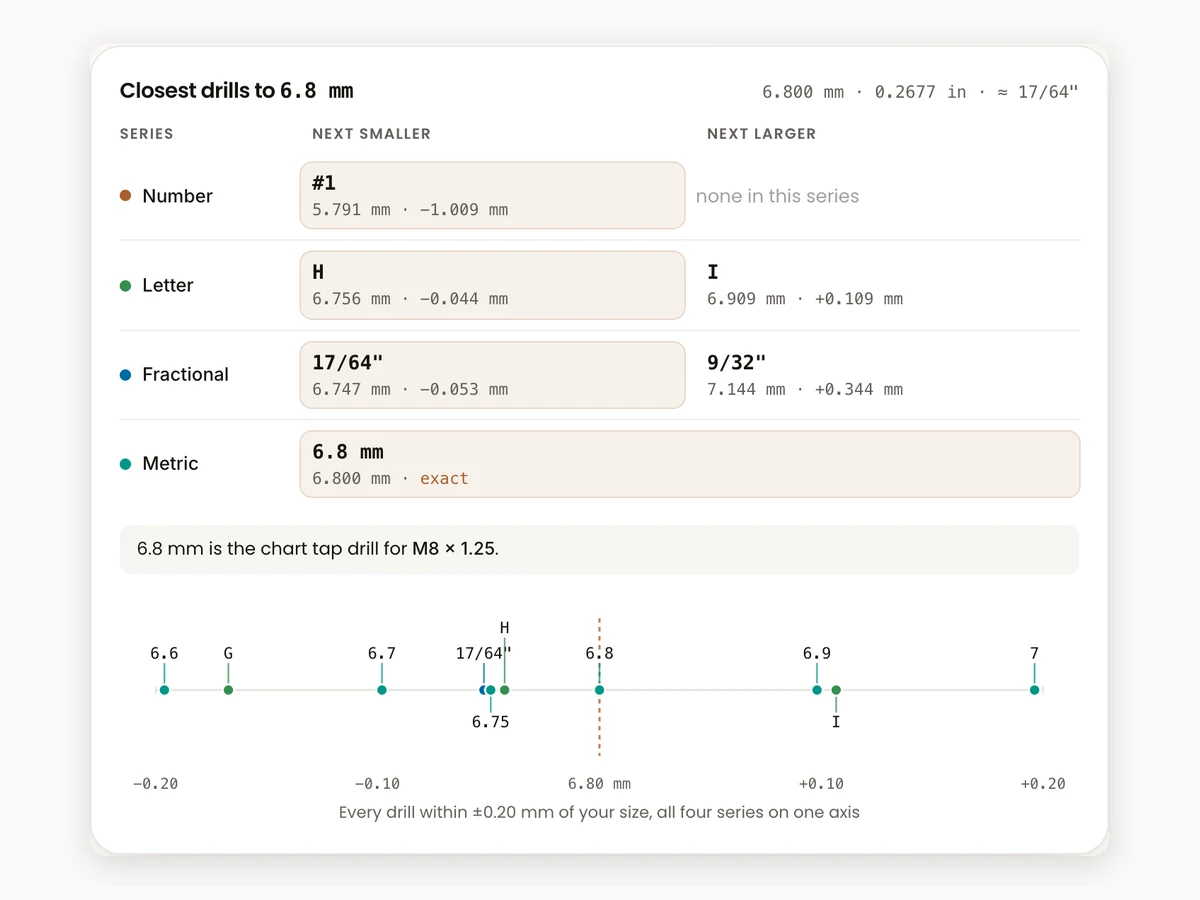
6.8 mm: exact metric, H is 0.044 mm under, 17/64" 0.053 mm under
How to
How to use the drill size chart
From a size on a drawing to the drill in your hand in three steps.
STEP 1
Type the size
Enter the hole size from the drawing in mm or inches, as a decimal, a fraction such as 1-1/4, or a drill name such as #29 or F.
STEP 2
Read the closest drill
Pick from the next smaller and larger drill of each series. The difference tells you how far each one is from the size you typed.
STEP 3
Print or copy
Open the full chart, filter the series you stock, and download the PDF for the wall or copy the rows into a spreadsheet.
Drilling for a tap?
Start from the thread, not the hole: the tap drill chart gives the drill for about 75 % thread.
Bolt passing through?
That is a clearance hole, a little over the bolt size. ISO 273 and ASME B18.2.8 list close, normal and loose fits.
Need an exact bore?
Drill a little under size and ream. Twist drills tend to cut slightly over their nominal size.
Metric drills only?
The nearest other system column gives the closest metric drill for every inch size, with the gap.
Specs
Drill chart coverage and sources
What is in the drill chart, how precise it is, and where each value comes from.
- Number drills
- #1 to #97 (97 sizes), 0.2280 to 0.0059 in, 5.791 to 0.150 mm
- Letter drills
- A to Z (26 sizes), 0.234 to 0.413 in, 5.944 to 10.490 mm
- Fractional drills
- 1/64 to 2 in in 1/64 steps (128 sizes), exact
- Metric drills
- 0.3 to 50 mm (251 sizes): 0.05 mm steps to 2.95, 0.1 mm steps to 13.9 plus the quarter sizes 3.25 to 9.75, then 0.5 mm steps
- Precision
- Inches to 4 decimals, mm to 3 on screen; CSV keeps full precision; 1 in = 25.4 mm exactly
- Sources
- ASME B94.11M values checked against the Engineers Edge and Xometry charts; #81 to #97 against RF Cafe and Xometry
- Output
- CSV to the clipboard; PDF on A4 or US Letter, two blocks per page, sources in the footer
- Where it runs
- In your browser tab; nothing is uploaded and no account is needed
It does
- Sort number, letter, fractional and metric drills together by size
- Find the closest drill from mm, inch decimals, fractions or a drill name
- Show the nearest drill of the other system and the gap
- Mark the chart tap drills for UNC, UNF, UNEF and metric threads
- Print or copy exactly the rows you filtered
It does not
- List reamer, end mill or step drill sizes
- Predict the real hole size, which depends on the drill and machine
- Give drill lengths, point angles or materials
- Tell you which sizes a shop has in stock
- Replace the supplier catalogue for critical holes
Where it helps
Where a drill size chart earns its place
Anywhere a size on paper has to become a drill in a chuck. To go from a thread to a drill, use the tap drill chart; to name a thread you measured, the thread pitch chart.

Machine shop drilling
Turn a callout like #29 or Ø6.8 into the drill in your index, and see the next size up if that one is missing.
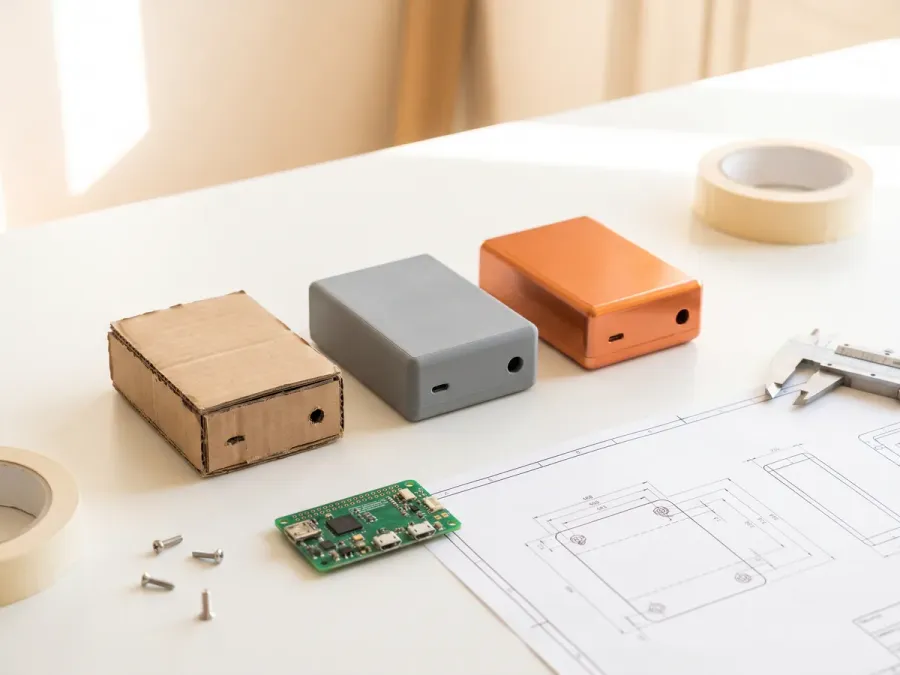
Prototypes and enclosures
Choose holes for screws, standoffs and heat-set inserts in printed or machined parts, inch or metric.
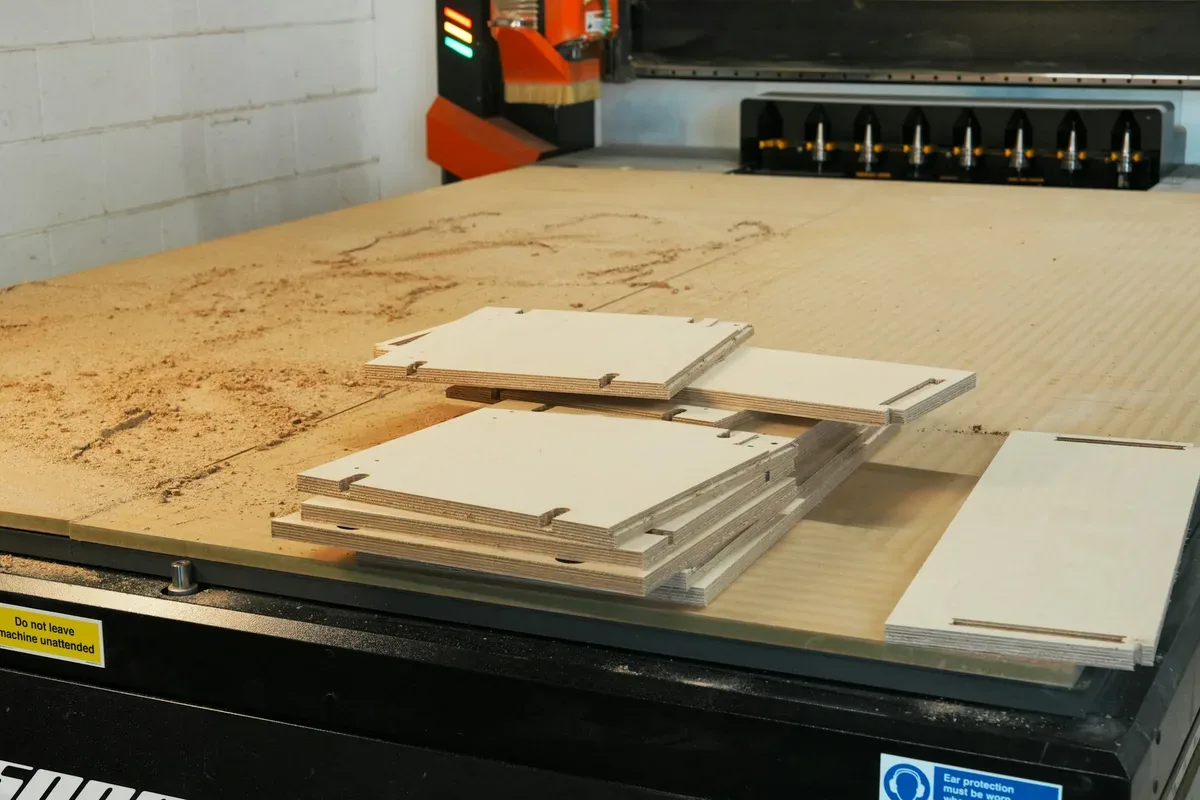
CNC and router jobs
Match a hole in the CAM file to a drill you actually own before the job starts, not halfway through it.

Drawings and parts lists
Write hole sizes in the unit the shop uses, with the decimal beside the drill name so nobody has to look it up.
Drill size chart FAQ
Drill names, sizes, conversions and what the chart leaves out.
How do I read a drill size chart?
Find the drill by its name (a number like #29, a letter like F, a fraction like 7/32 or a metric size like 6.8 mm) and read its diameter in inches and millimetres. The rows are sorted by size, so the rows above and below are the next smaller and larger drills of every series.
What size is a #7 drill?
A #7 drill is 0.2010 in, or 5.105 mm. It is the usual tap drill for a 1/4-20 UNC thread, giving about 75 % thread, and the closest metric drill is 5.1 mm.
What is the difference between number, letter and fractional drills?
Number drills run from #97 (0.0059 in) up to #1 (0.2280 in), and letter drills carry on from A (0.234 in) to Z (0.413 in). They fill the gaps between the 1/64 inch steps of fractional drills, which is why tap drill and clearance charts so often name them.
What does a number drill size chart cover?
The number drill size chart here lists #1 to #80, the common gauge drills, plus the micro sizes #81 to #97. The numbers grew out of an old wire gauge, so they follow no formula and a bigger number means a smaller drill.
Which sizes are in the letter drill size chart?
The letter drill size chart runs from A at 0.234 in (5.944 mm) to Z at 0.413 in (10.490 mm), picking up just above #1. Letter E is 0.250 in, the same as a 1/4 in drill.
Is a letter E drill the same as 1/4 inch?
Yes. Both are 0.2500 in, or 6.350 mm exactly. The table shows them in adjacent rows with the same size.
What is 17/64 in mm, and is it close to letter H?
17/64 in is 0.2656 in, or 6.747 mm. Letter H is 0.2660 in, just 0.0004 in larger, and the nearest metric drills are 6.75 mm and 6.8 mm.
Which metric drills does the chart list?
251 sizes from 0.3 to 50 mm: 0.05 mm steps up to 2.95 mm, 0.1 mm steps up to 13.9 mm with the quarter sizes 3.25 to 9.75 mm, then 0.5 mm steps. Not every in-between size is stocked everywhere; sets usually step by 0.5 mm.
Will the hole come out exactly at the drill size?
Not quite. The chart gives nominal drill diameters; a twist drill usually cuts a little over size, and the machine, the sharpening and the material change the result. For a precise hole, drill under size and ream.
What drill size do I use for a tapped hole?
Start from the thread: a 1/4-20 UNC tap takes a #7 drill and an M8 × 1.25 tap a 6.8 mm drill. The tap drill chart lists every UNC, UNF, UNEF and metric thread with the percent of thread each drill gives.
Can I print this drill bit size chart?
Yes. The PDF button writes the rows you see, two blocks per page on A4 or US Letter, with the sources in the footer. Copy CSV puts the same rows on your clipboard at full precision for a spreadsheet.
Is the drill size chart free, and does it send anything?
It is free, with no account. The finder, the table and the PDF all run in your browser, so nothing you type is uploaded.
Find your drill in the drill size chart
Type a size, read the closest drill in every series, print what you need.
Open the finder