Phone Stand Design Tool: CAD Drawing and STL
Start your phone stand design from the phone: set its thickness with the case, the viewing angle, the lip and a cable slot, and the maker builds a live 3D model, a dimensioned phone stand drawing and a printable STL. Or describe a stand and AI draws a CAD-style picture.
- Slot sized to your phone
- Live 3D model
- Dimensioned drawing
- Free STL and DXF
Drawing style
Technical
Full sheet: views, a section, notes and a title block.
You get a CAD-style PNG made by AI, not an editable CAD file. Trace it to DXF for free afterwards.
Adjustable stand, drawing sheet
AI-generated example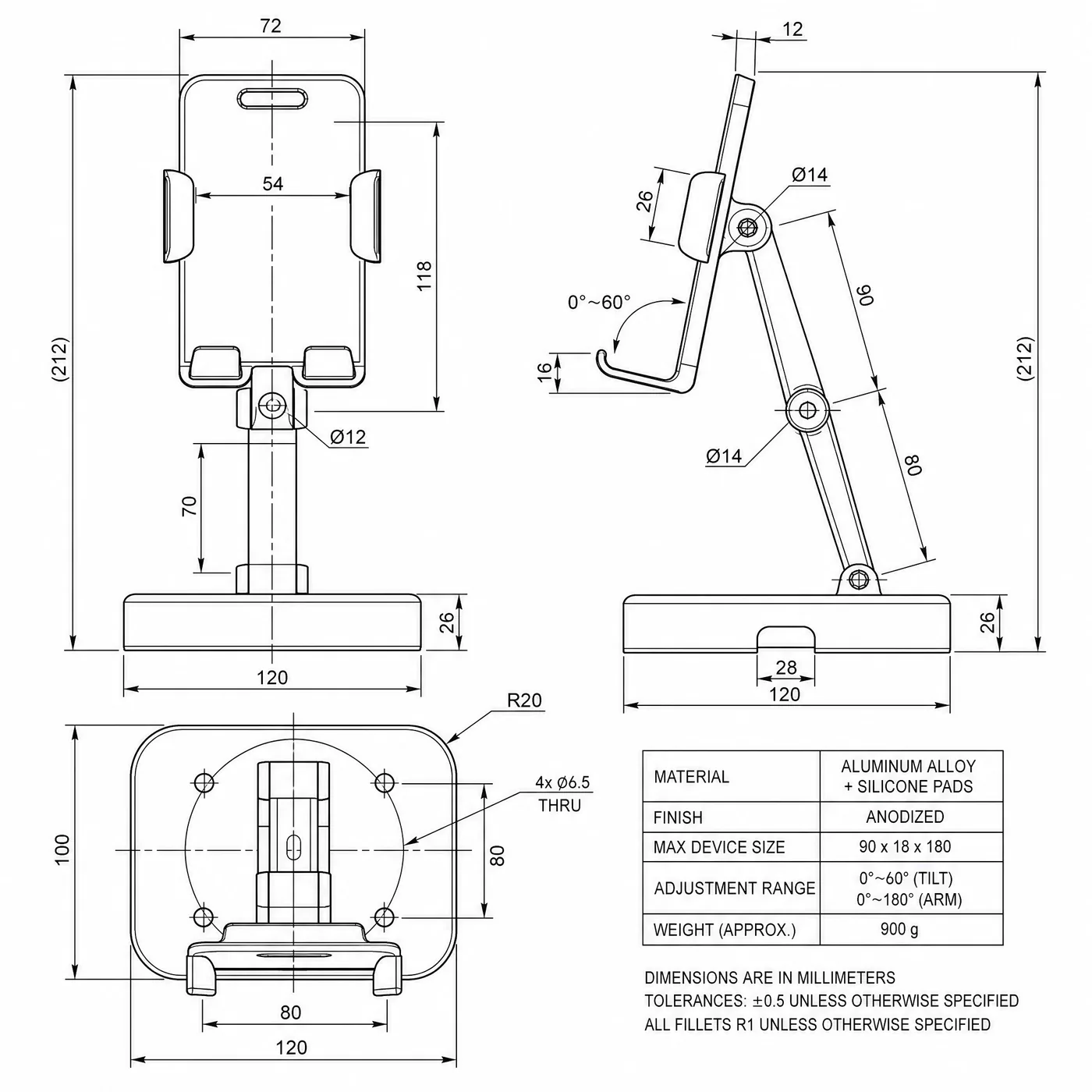
Prompt idea: Adjustable desk phone stand with a cradle and side grips on a hinged arm, a 120 x 100 mm weighted base with four holes, 0 to 60 degree tilt; front, side and top views with dimensions and a spec table. Your result will differ.
Free stand maker
Phone stand design maker: slot, angle and STL
Change any number and the stand rebuilds: slot, lip, back rest, base, window and cable slot. Turn the 3D model, read the phone stand drawing, check the tip margin, then download the STL to print. It all runs in your browser and nothing is uploaded.
Phone
Angle and slot
At a desk, a steeper stand (60 to 75°) keeps your head more upright.
Room under the phone for the cable plug.
Body
Cable slot
A little wider than your cable plug.
- Slot
- 12 mm
- Size D × H × W
- 100 × 95 × 70
- Screen top
- 159 mm
- Footprint
- 95 mm
- Volume
- 102.7 cm³
- PLA, solid
- 127 g
- Tip margin
- 46 mm
- Push to tip
- 90 gf
On its side, every layer holds the whole profile, so the back rest is strongest. With the cable slot, add supports under the slot roof.
Mass: solid PLA at 1.24 g/cm³; your slicer gives the real figure. Tipping uses the phone plus 64 g of stand (half the solid mass) and a push square to the screen at its top edge. Print a test before you trust it with your phone.
Examples
Phone stand drawing examples
Three sheets made with the maker above, each with its STL, next to AI pictures from the generator at the top of the page.
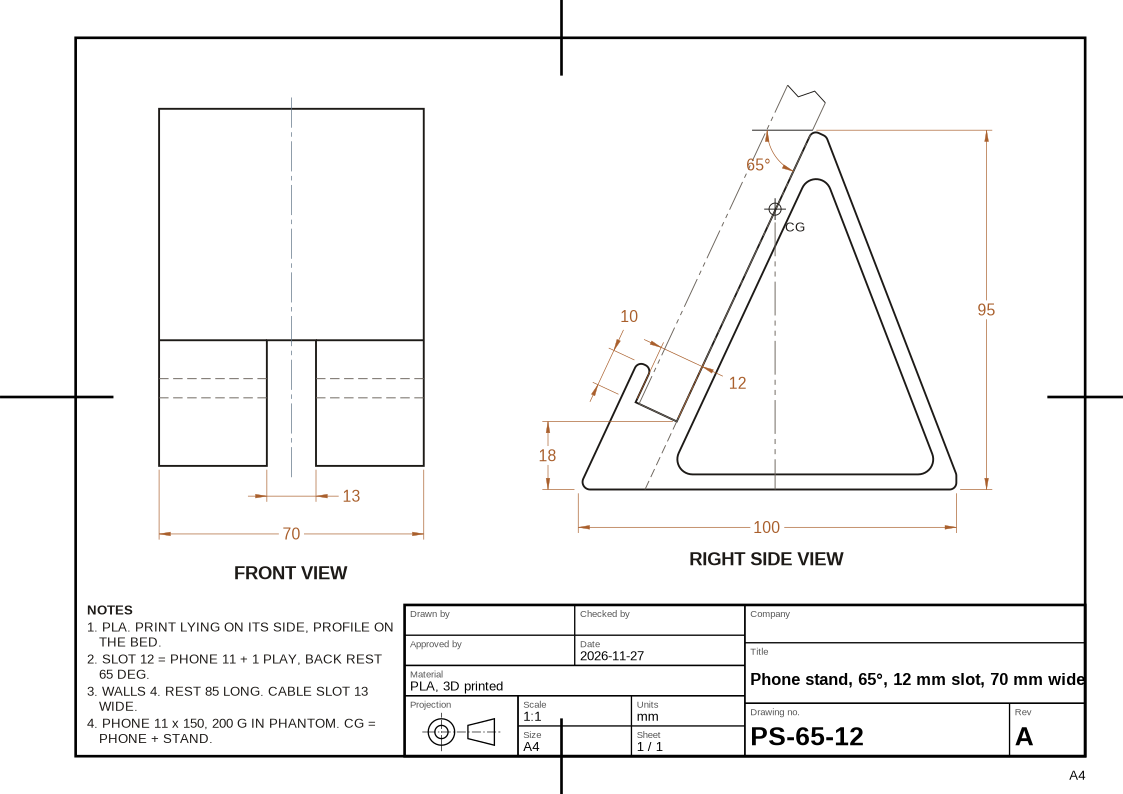
Made with the maker
Desk stand at 65 degrees
A 70 mm wide stand for an 11 mm phone in a case: 12 mm slot, 10 mm lip, cable slot and a window behind the rest. About 127 g of PLA if printed solid.
65° · 12 mm slot · 70 mm wide · 127 g solid
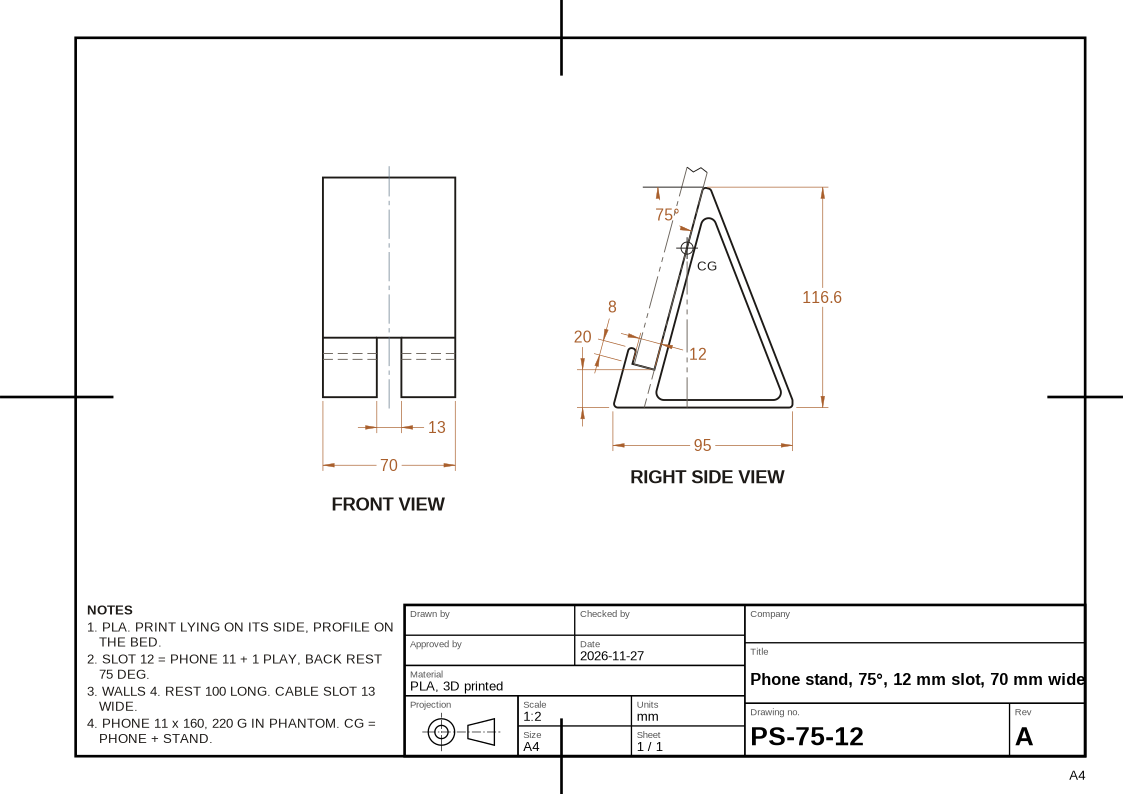
Made with the maker
Video call stand at 75 degrees
A steeper rest and a taller phone lift the top of the screen to about 177 mm, closer to eye level on a desk, on a 95 mm deep base.
75° · screen top 177 mm · 95 mm base
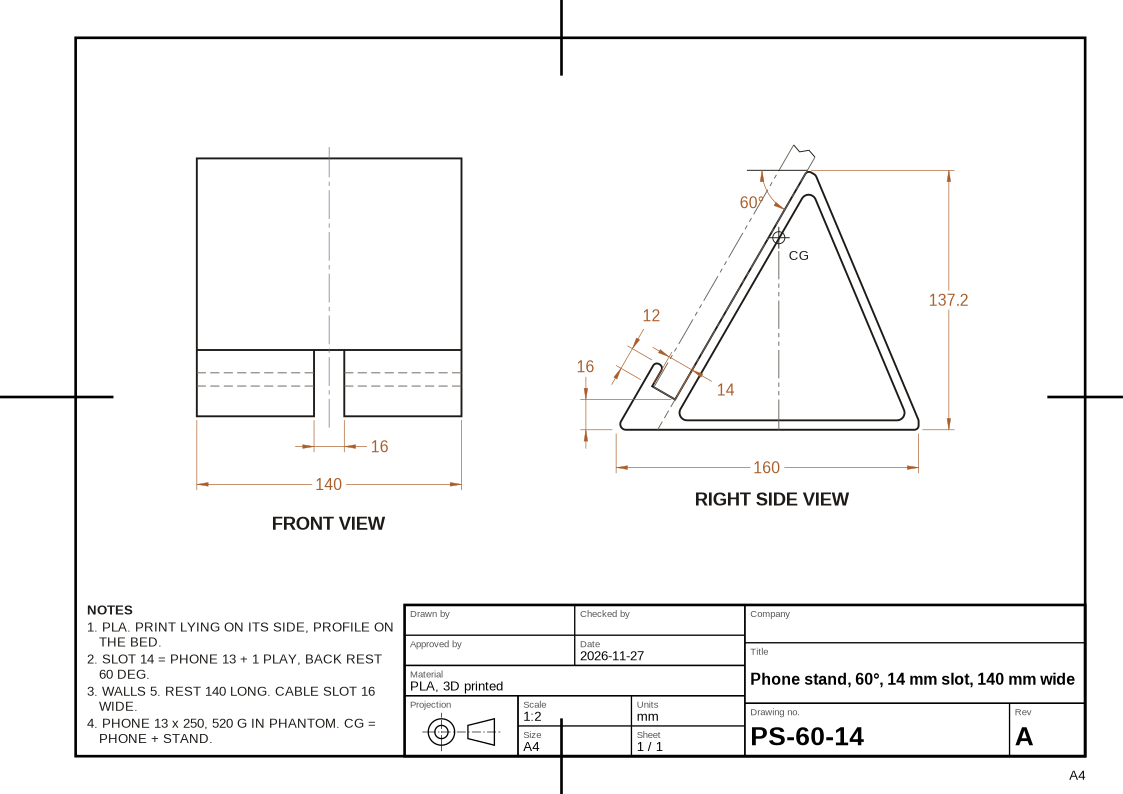
Made with the maker
Tablet stand at 60 degrees
A 140 mm wide stand for a 13 mm tablet in a case, with a 140 mm rest and a 160 mm base to carry 520 g.
60° · 14 mm slot · 140 mm wide · 160 mm base
AI-generated example
Adjustable stand, drawing sheet
Front, side and top views with a tilt range and a spec table. Good for a concept; the numbers are illustrative.
AI-generated example
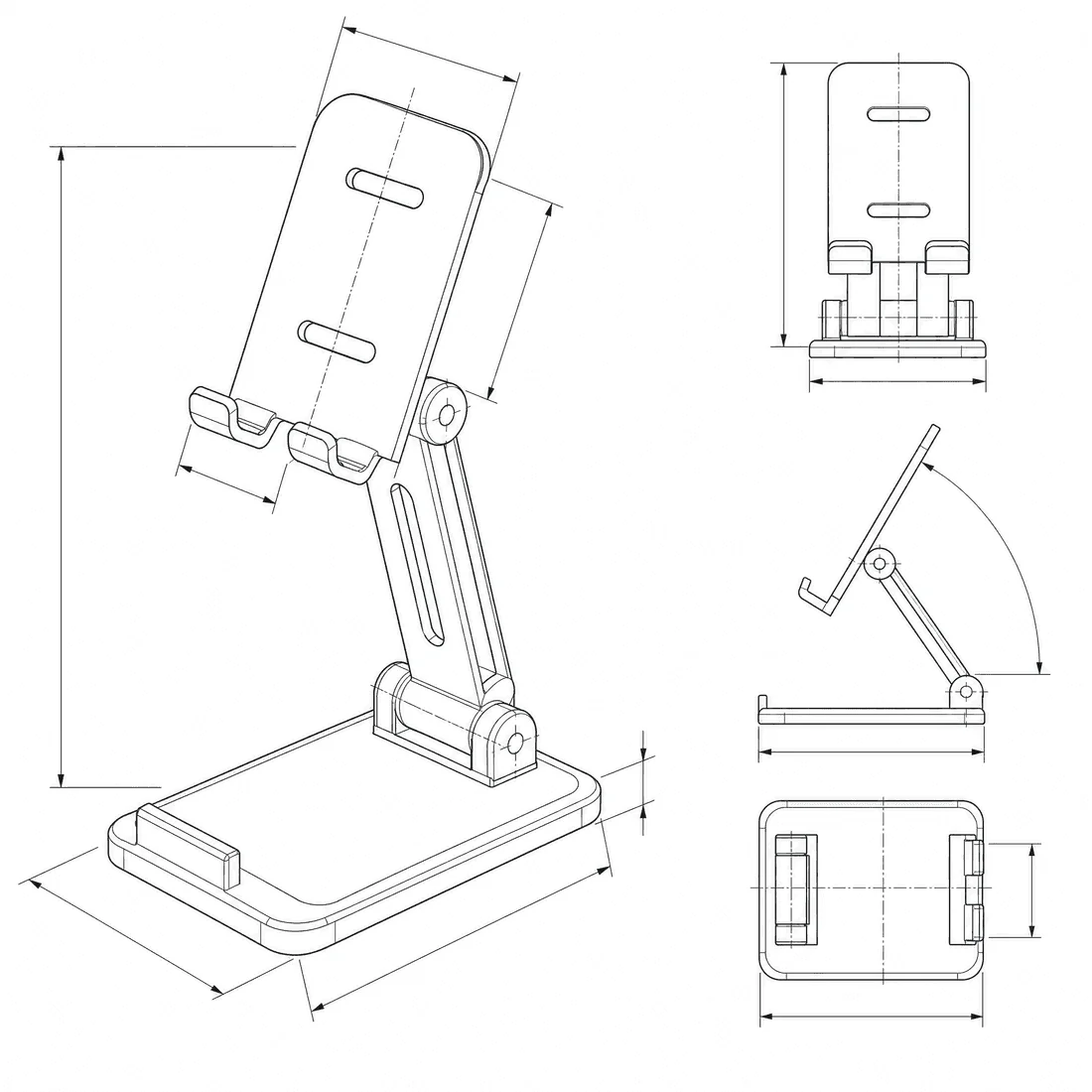
Foldable stand with views
An isometric view of a hinged stand next to its front, side and top views.
AI-generated example
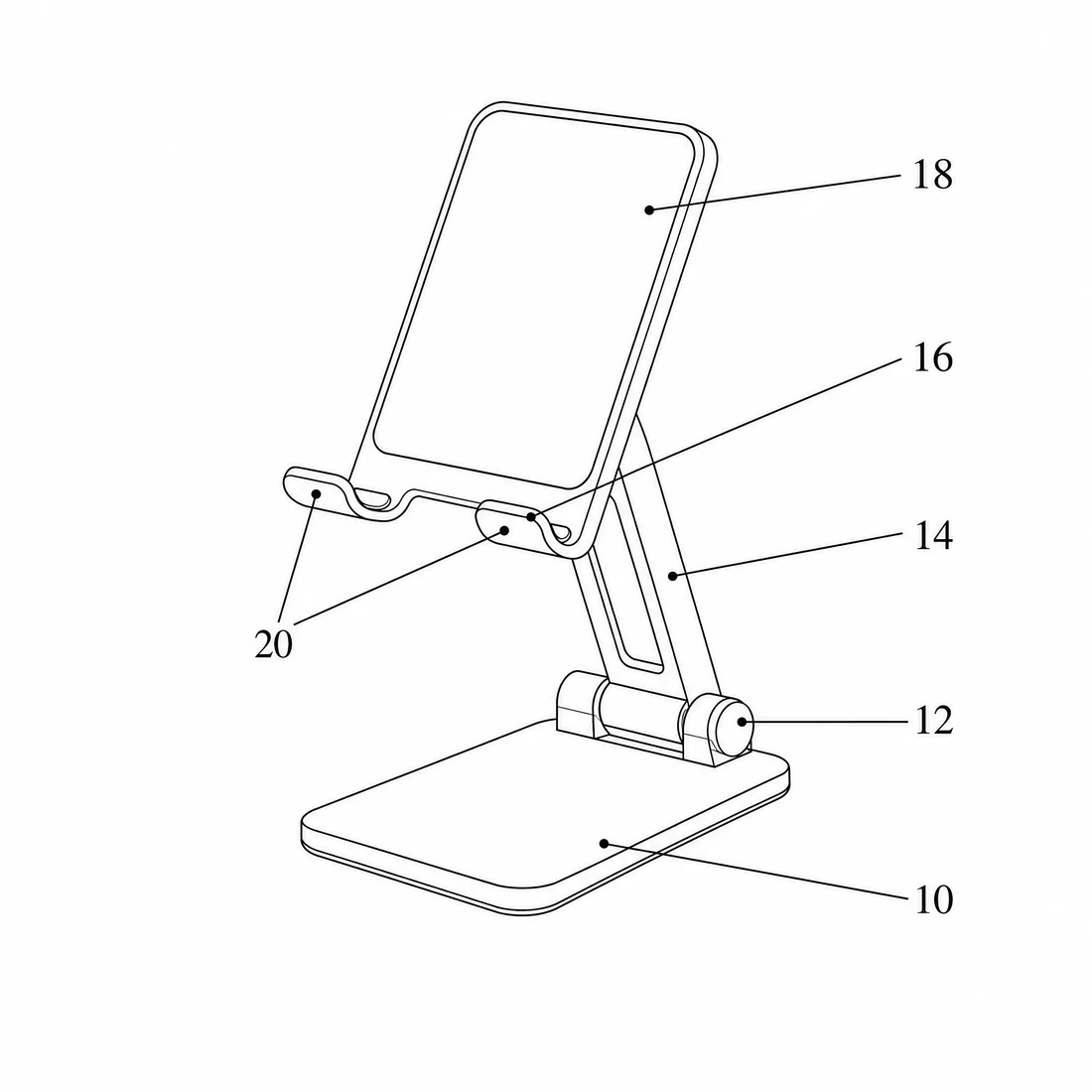
Patent style figure
A foldable stand in perspective with reference numerals for the base, hinge, arm and cradle.
Prompt builder
Describe a phone stand CAD drawing for the AI
Pick the stand type, the phone, the angle, charging and the views. Apply writes one clear prompt into the generator at the top of the page.
Generated prompt
TechnicalStart from a template
Design rules
Phone stand design rules the maker follows
Five habits behind a stand that holds the phone, stays put and prints well. The maker applies them as you type and flags anything that breaks one.
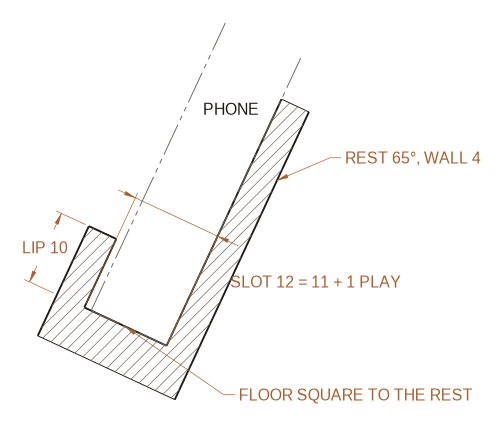
Slot, floor and lip, drawn by the maker
How to
How to make a phone stand drawing in 3 steps
With the free phone stand design maker; the AI generator at the top works from words or a sketch instead.
STEP 1
Measure your phone
Enter the thickness with the case, the height and the mass. Pick a starting point such as Desk phone or Tablet.
STEP 2
Set angle, lip and base
Choose the viewing angle, the lip and the seat height, then the rest, base and width. Watch the tip margin as you go.
STEP 3
Download and print
Save the STL for your slicer, the sheet as PDF, SVG or DXF, or the 1:1 profile for a laser cut version.
Measure with the case
Cases add 2 to 4 mm; a slot sized for a bare phone will not fit.
Check the plug
Make the cable slot a little wider than your plug and the seat high enough for it.
Print a test
Print a short slice of the slot first to check the fit before the full stand.
Add rubber feet
Small pads under the base stop it sliding when you tap the screen.
Two tools
Maker or AI: which phone stand CAD tool to use
The maker is exact about what it builds; the AI is quick at a first picture.
- Maker input
- Phone thickness, height and mass, angle, lip, seat, rest, base, width, wall, cable slot
- Maker output
- STL (on its side or standing), A4 or A3 sheet as SVG, PDF and DXF R12, 1:1 profile DXF
- Checks
- Slot fit, tip margin, push to tip, solid volume and PLA mass
- Maker cost
- Free, no account, nothing uploaded
- AI input
- A written description, or a sketch or photo (PNG, JPG or WebP up to 10 MB)
- AI output
- A CAD-style PNG at 1K or 2K, not an editable CAD file
- AI cost
- 60 credits at 1K, 80 at 2K; refunded if a run fails
It does
- Size the slot from your phone and its case
- Build a closed, printable STL with a live 3D view
- Draw a dimensioned front and side view, 1:1 when it fits
- Estimate the tip margin and the PLA mass
- Draw a first AI picture of a stand from words
It does not
- Check strength or how much the rest bends
- Model hinges, folding stands or ball joints
- Know your slicer settings or real print weight
- Fit a wireless charger pad yet
- Turn the AI PNG into an STL by itself
Phone stand design FAQ
Fit, angle, printing, files and the two tools.
What is the best angle for a phone stand?
It depends on use. Around 55 degrees suits reading and typing, 65 degrees is a good desk default, and 70 to 75 degrees suits video calls and watching. On a table, steeper stands keep your head more upright.
How wide should the slot be?
Phone thickness with its case plus about 1 mm of play. A modern phone is 7 to 9 mm thick and a case adds 2 to 4 mm, so most slots end up between 10 and 14 mm.
How high should the front lip be?
Eight to twelve millimetres holds most phones. Under 5 mm the phone sits loosely; over 20 mm the lip may cover the bottom of the screen.
Will the stand tip over?
The maker checks it. It puts the phone and the stand together, finds the centre of gravity and shows how far it is from the rear edge, plus the push at the top of the screen that would tip it back. Make the base deeper if the margin turns amber.
Which way should I print a phone stand?
On its side, with the profile on the bed: each layer then holds the whole profile and the back rest is strongest. With the cable slot on, the slicer needs supports under the slot. Printing it standing needs no supports but is weaker.
What material and infill should I use?
PLA or PETG with three or four walls and 15 to 20 percent infill is a common start for a desk stand. PETG copes better with a warm car. The mass shown is for a solid part; your slicer gives the real weight.
Can I make a tablet stand with it?
Yes. Set the tablet height, thickness and mass, widen the stand and lengthen the rest and base. The Tablet starting point is a 140 mm wide stand at 60 degrees.
Can I open the phone stand CAD files in other programs?
Yes. The STL opens in any slicer and in CAD tools that read meshes. The DXF files are R12 with layers for outline, hidden lines, phantom lines and dimensions, so they open in AutoCAD, Fusion, FreeCAD and LibreCAD.
Can I laser cut the stand instead?
Yes. The 1:1 profile DXF is the side shape with its window. Cut two or three side plates from plywood or acrylic and join them with a back plate or spacers of your own design.
Is the phone stand drawing to scale?
Yes. A phone stand is drawn at 1:1 when it fits the sheet, otherwise at 1:2 or 1:5, and the scale is in the title block. Print a 1:1 PDF at 100 percent and you can hold your phone against the profile.
What does the AI phone stand drawing generator make?
A CAD-style PNG of a stand from your words or a sketch, at 60 credits for 1K or 80 for 2K. The dimensions on it are illustrative, and Convert to DXF traces its lines for free, not to scale.
Is this phone stand design tool free?
The maker, the STL, the sheet, the profile DXF and the trace to DXF are free with no account. Only AI pictures use credits, and a failed run is refunded automatically.
Start your phone stand design
Make a stand that fits your phone, with a drawing and a free STL, or describe one and let AI draw a first picture.
Describe a phone stand